Why Have Hostile Actors Turned to Social Media Against Israel?
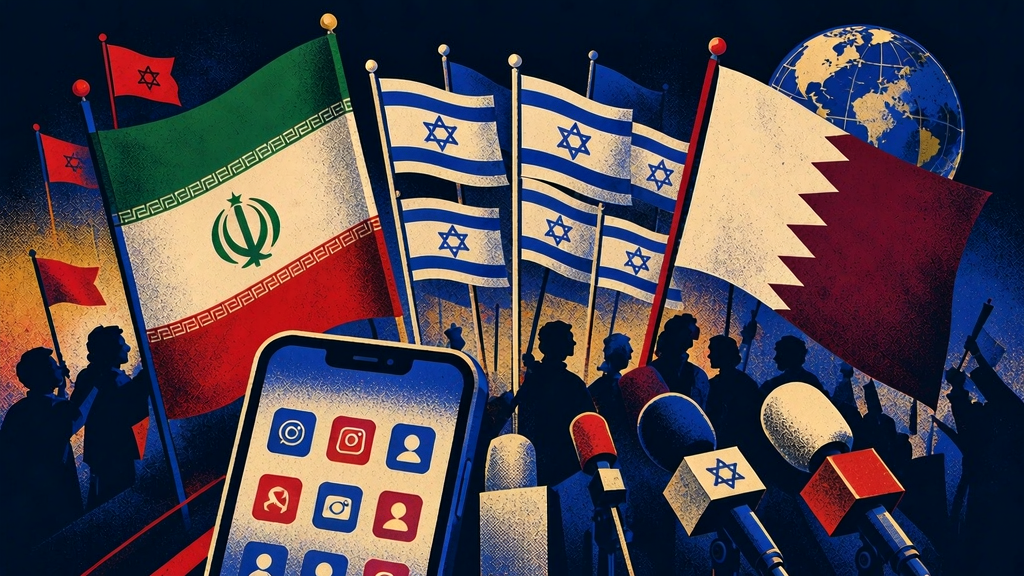
Hostile actors turned to social media against Israel because it is cheaper than rockets, deniable, and it reaches the legislators, journalists and voters of Israel’s allies, not only its enemies. The one-year anniversary of the Israel-Hamas war marked how offline and online violence have become different sides of the same coin. As Israel continued its military response in Gaza — a war whose toll on Palestinian civilians, and whose destruction of housing, hospitals and universities, human-rights organisations and UN bodies have documented extensively — researchers found that most Americans were exposed to hateful online misinformation about the war (ADL). Meta’s Threat Disruption Center has warned that after Russia, Iran conducts the most covert influence operations on its platforms, and in December 2024 it exposed activity backed by the Islamic Revolutionary Guard Corps alongside a Lebanon-based network tied to the pro-Hezbollah al-Mayadeen outlet and the Iran-linked LuaLua TV network (FDD). The battleground is real. The question is who is behind it, with what money, and with what effect.
How Do Fake Accounts Target Israel on Social Media?
Who is behind the anti-Israel social media campaigns? One fourth of anti-Israel accounts are fake, according to the report by the AI-authenticity firm Cyabra. Cyabra showed that 25 percent of users interacting with and boosting salient anti-Israel influencers such as Motaz Azaiza, Anastasia Maria Loupis and Jackson Hinkle are fake: of 162,000 profiles participating in war discourse, 40,695 were fake accounts, part of a coordinated bot network spreading over 312,000 posts and comments within two days, including Hamas bot posts promoting the narrative that taking dozens of Israeli civilians hostage was justified (Jerusalem Post). Posts like those justifying the hostage-taking had a potential reach of 230,000,000 views (Boundless). A second campaign, ISNAD, was founded by Ezzeldeen Dwidar, an Egyptian film producer associated with the Muslim Brotherhood who lives in Turkey, and operates hundreds of volunteer-run fake Israeli profiles on X, claiming 800,000 Hebrew tweets — about 2.5 percent of all Hebrew tweets during that period (INSS). On the Iranian side, the FBI and Israel’s National Cyber Directorate linked Meta-observed activity to the IRGC-controlled front company Aria Sepehr Ayandehsazan. And one network was aimed not at Israel but at Americans: the Israeli political consulting firm STOIC, which The New York Times reported is being paid $2 million by Israel’s Ministry of Diaspora Affairs to influence Democratic members of Congress, ran five covert websites targeting mostly younger Americans — including one labeling American universities as “safe” or “unsafe” for Jewish students. Meta removed 510 Facebook accounts connected to it. Minister Amichai Chikli denied the reports, and Israel’s former ambassador Michael Oren called the campaign “inappropriate interference in the internal politics of our most important ally” (NPR).
How Widely Do the Anti-Israel Disinformation Campaigns Reach?
Reach claims deserve their own audit, because potential reach is not confirmed readers. Cyabra measured the potential eyes of over 531 million profiles for its fake-network content. Argyle Consulting Group found that 60 percent of the most viral posts on X mentioning “Iran” during the first week of a 2026 US strike operation originated from accounts based outside the United States, often presenting themselves as American voices, with foreign accounts generating 155.6 million views in the sample (Fox News). The traction data, however, cuts against alarmism. Tech companies found the STOIC campaign did not gain meaningful traction online, and Meta deleted its fake accounts before they gained any attention from real people (NPR). Meta likewise dismantled the Iranian and Hezbollah operations before their disinformation content garnered significant attention, concluding generative AI only marginally enhanced their efficacy (FDD). OpenAI’s August 2024 takedown of the Iranian network Storm-2035, which posted about Gaza and Israel, found most posts drew little or no engagement (OpenAI). Pew found 60 percent of US adults viewed Israel unfavorably in March 2026, a double-digit jump from 2022 — a broad shift no study has traced to Iranian or Qatari operations. Americans changed their minds about the war on their own.
How Does Iran Influence Activism in Other Countries?
Iran’s quiet reach — mapping Tehran’s influence and radicalisation efforts across Europe — is how researchers describe the pattern. As Iran navigates domestic unrest and geopolitical shifts, its influence operations abroad are intensifying, and Tehran’s strategies are shaping radicalisation risks across Europe, with a focus on recruiting and steering proxy networks rather than building mass audiences. The pattern reported in Europe runs through Tehran’s intelligence services: recruiters and handlers cultivating activist and proxy circles, seeking leverage over communities and movements rather than direct ownership of them. The clearest documented case of how Iran influences activism in other countries is kinetic, not viral: the Aria Sepehr Ayandehsazan operation’s threatening text messages to Israeli athletes at the Paris Olympics — intimidation designed to disrupt events and generate fear among diaspora communities (FDD). What the record does not show is direction of American protest: no independent evidence has emerged that Iran directed the New York vigil protest or any comparable demonstration, and no study attributes the shift in American public opinion to Tehran’s operations. Steering proxies is not the same as running the movements of foreign citizens, and the evidence for the first should not be confused with the second.
Why Does Qatar’s Messaging on Iran Raise Concerns?
Qatar’s regional crisis messaging and the politics of image raise concerns because of structure, not content. On 30 July 2026, the U.S. State Department warned Americans globally to be aware of the escalating tensions between Teheran and Washington. As a result, Qatar has been forced to navigate a rapidly intensifying regional conflict in which Iran’s role is a principal factor (Qatar Centre for Peace and Democracy). True to its traditional approach, Qatar has not burned its bridges with Iran; its anger toward Tehran appears largely rhetorical, aimed at preserving alignment with the Gulf states and Washington. Doha maintains long-standing, friendly ties with Tehran, including a shared gas field and energy interests, which give its regional crisis messaging an ambiguity other Gulf states lack — a politics of image in which a mediator markets itself as indispensable to every side at once. Ambiguity is not evidence, however. No platform report or government disclosure has documented coordinated Qatar–Iran messaging on the Gaza war. The 2026 record runs the other way: Iran struck Qatar repeatedly, Qatar expelled Iranian military attachés, then helped mediate the subsequent US–Iran memorandum and welcomed it. Leverage and results, not blank checks, is the model Doha’s mediation actually illustrates — and it is the same standard worth applying to every ally’s aid.
Do Qatar and Iran Coordinate Their Messaging — and Is Qatar Changing Its Approach to Iran?
Is Qatar changing its approach to Iran following Tehran’s strikes against it — from friend to foe? The question deserves scrutiny; the coordination claim does not yet survive it. A dramatic reversal would be visible in Gaza messaging, and nothing public documents one. What the 2026 record documents is a mediator under fire: strikes on its territory, the expulsion of Iranian military attachés, and then mediation of the US–Iran memorandum. True to its traditional approach, Qatar has not burned its bridges with Iran, and its anger toward Tehran appears largely rhetorical, aimed at preserving alignment with the Gulf states and Washington rather than abandoning engagement. A government that hosts the party shooting at it while brokering the settlement is practicing leverage, not coordination. On the specific question of whether Qatar and Iran coordinate their messaging: no public evidence supports it. Shared talking points would surface in platform takedown reports or academic network analyses, and none has. The concern is worth watching; the conclusion is not yet earned.
What Are the Primary Sources of Foreign Funding Influencing Media Coverage?
The primary foreign funding influencing media coverage around Gaza is, notably, not Qatari or Iranian. The best-supported paper trail belongs to the $2 million paid by Israel’s Diaspora Affairs Ministry — a government ministry of a state receiving $3.8 billion a year in American military aid under a ten-year agreement, while America carries a $38 trillion debt — for a covert campaign targeting US lawmakers (though the minister disputes it) (NPR). That is not a hostile-actor story; it is a taxpayer-accountability story. Achiya Schatz, whose Israeli watchdog FakeReporter identified the STOIC websites, put the standard plainly: “I don’t trust these kinds of tools in the hands of anyone” — any government, ally or adversary. The consistent position is not suspicion of one ally; it is the same test for every ally: disclosure and reciprocity, applied with equal force where the paper trail is strongest. Criticizing a government’s covert spending is not hostility to its people — Israelis themselves, from former ambassadors to watchdog researchers, raised these exact alarms about their own state’s conduct, and many American Jews and rabbis disagree with the war policy as well. What American taxpayers are entitled to ask — of Qatar, of Iran, and of every recipient of American aid — is what the money bought, whether it moved votes, and what the return was on the influence the disclosure now makes visible.